Revised Fall 2025
Research and Citation Guide
NONVIOLENCE RESEARCH:
PRACTICE AND THEORY
Here we present a template of provisional definitions for nonviolence researchers (not a final answer, just a starting guide).
Working definition of Nonviolence
Theory and practice of resilience that resists structures of injustice, de-escalates cycles of violence, and sustains pluralistic forms of empowerment.
Recent work on resilience theory for education
ahmed Shafi, Adeela, Tristan Middleton, Richard Millican, and Sian Templeton, eds. Reconsidering Resilience in Education: An Exploration Using the Dynamic Interactive Model of Resilience, Springer International Publishing, 2020. https://doi.org/10.1007/978-3-030-49236-6.
Ch. 13 synthesizes the book’s Dynamic Interactive Model of Resilience (DIMoR) with the Competences in Education for Sustainable Development (CESD) that were developed by the United Nations Economic Commission for Europe (UNECE) Strategy for Education for Sustainable Development (Learning for the Future.) As a result, Richard Millican and Paul Vare present “A Rounder Sense of Purpose: Educator Competences for Sustainability and Resilience,” which are summarized in table form at the Rounder Sense of Purpose (RSP) website here.
But what is violence?
The Oxford English Dictionary begins with: “The deliberate exercise of physical force against a person, property, etc.; physically violent behaviour or treatment; (Law) the unlawful exercise of physical force, intimidation by the exhibition of such force. Formerly also: †the abuse of power or authority to persecute or oppress (obsolete).”
Wikipedia: “Violence is characterized as the use of physical force by humans to cause harm to other living beings, such as pain, injury, disablement, death, damage and destruction.
Johan Galtung identifies three forms of violence: direct, cultural, and structural.
NESTED REALMS OF NONVIOLENT RESILIENCE: A TEMPLATE FOR RESEARCHERS (NRNV-R)
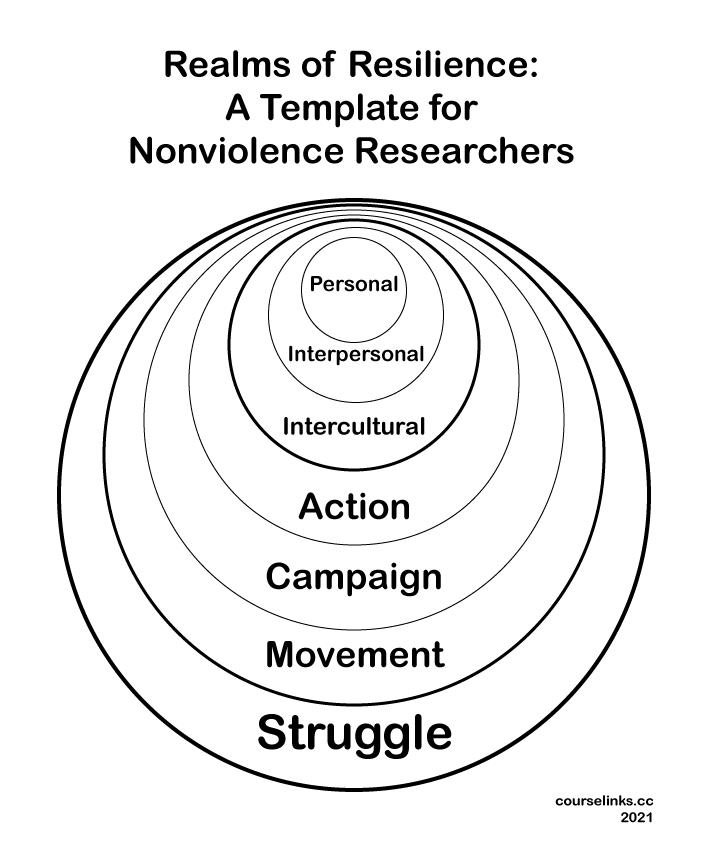
Struggle Nonviolence
Persistent multi-generational structures of injustice call forth resilient social habits and institutions.
Sample Research Topics
-STRUCTURE: Colonialism, [Racism, Poverty, War,]* Oppression, Privilege, Violence. (*MLK, Jr.’s Triple Evils).
–Institutions: Family, Schools, Churches, Law Making, Law Enforcement, Courts, Real Estate, Production, Military
“Now, when I say questioning the whole society, it means ultimately coming to see that the problem of racism, the problem of economic exploitation, and the problem of war are all tied together. (All right) These are the triple evils that are interrelated.” – MLK, Jr. “Where Do We Go from Here?“
-RESILIENCE: Freedom, Equality, Democracy, Education, Faith, Family, Culture, Nonviolence
–Community Struggles: Family, Schools, Churches, Community Organization, Housing, Resources, Defense
Here we use the term “struggle” to indicate that nonviolence may be found in everyday community practices of family, school, church, and cultural activities.
Gandhi’s “Constructive Programme”
“The Indian constructive programme includes establishing unity among the various religious and cultural groups in India, the removal of untouchability, abolition of the use of intoxicants and narcotics, de-centralized economic production and distribution, village sanitation, a programme of adult education, acceptance of the rights of women, education in health and hygiene, preservation of the native languages of India and the extension of Hindi as a national language, economic equality, work with the peasants, the development of non-violent labour unions, work with the hill tribes, care of the lepers and work with the students.” – Gene Sharp. Gandhi Wields the Weapon of Moral Power (Three Case Stories). Ahmedabad: Navajivan, 1960. https://www.mkgandhi.org/ebks/gandhi-wields-the-weapon-of-moral-power.pdf
Movement Nonviolence
Multi-decade struggles for milestone victories.
Sample Research Topics
-Then: Abolition, Suffrage, Civil Rights
-Now: New Abolitionism, Voting Rights, Climate Justice, Equal Pay
Here we use the term “movement” to indicate that social change is often the result of multiple, often competing, sometimes conflicting organizations and campaigns.
Campaign Nonviolence
Social actions that address specific provocations or grievances, usually with defined start and end dates. Sometimes these campaigns may be viewed as parts of larger movements or struggles.
[Not to be confused with this Campaign Nonviolence, although the coincidence is timely.]
Sample Research Topics
-Then: Montgomery Bus Boycott, Selma, March to Sacramento
-Now: Fridays for Future
Activist organizations may often be studied in the context of “campaign” nonviolence: their founding, their membership, and their activities tend to play some circumscribed role in larger processes of social change.
In nonviolence studies, we are interested in the problem of converting grievances into campaigns, and campaigns into victories of resilience over structural injustice. Sometimes the scope of effort requires what we here call a “movement” of many overlapping, even conflicting, “campaigns.” However, given the limited time and space of a semester research project, “campaigns” tend to be the main focus of our research projects.
For example, in the philosophy of nonviolence taught by MLK, Jr., a well-founded campaign requires (1) analysis of injustice, (2) affirmation of guiding principles of struggle, (3) a set of steps to guide organization and action, and (4) a vision of what nonviolence seeks to achieve. (“The King Philosophy – Nonviolence 365“)
The Kingian model offers a template for researchers with respect to any field of social change. Scholars of nonviolence would augment each component with a survey of literature from social science, history, and philosophy.
A Template for Researching Nonviolence Campaigns
(the “Modified Bondurant Checklist” adapted from Joan V. Bondurant, Conquest of Violence 45-50).
“To introduce some consistency into the treatment of these satyagraha movements—and the better to test them for their genuineness as true satyagraha—I have outlined each according to the following ten points: 1.Dates, duration, and locale 2.Objectives 3.Satyagraha participants and leadership 4.Participants and leadership of the opposition 5.Organization and constructive program 6.Preparation for action 7.Preliminary action 8.Action 9.Reaction of opponents 10.Results” (Bondurant, Joan Valerie. Conquest of Violence. Princeton University Press. Kindle Edition)
Note a similar organization of categories at the Swarthmore Global Nonviolent Action Database. Here’s an example from the campaign to establish a Gay-Straight Alliance at the Flour Bluff, TX, High School.
Here the emphasis may be placed on scholarly reconstruction of historical campaigns, or it may be applied to active organization in real time.
What is the Grievance or Provocation?
How do we (or how did a historical movement or campaign) select a specific provocation or grievance to address? How can the problem be documented (or how was it documented)? How is the problem understood theoretically? (Or how was the problem understood?) And how is our understanding of the problem affected by the nonviolence frame, i.e. by our attempt to transform a grievance into a campaign?
What values are explicit or implicit as the campaign is declared and carried out?
What values allow us (or allowed some historical movement) to illuminate and communicate the moral significance of the problem? How is our selection of values, principles, and methods affected by the nonviolence frame?
What principles are implicit or explicit?
What principles should we adopt (or were adopted by a historical movement) to define and discipline our approaches to transformation?
What are the goals?
What change should we seek? (Or what change was sought by a historical movement?) By what measure will we know when the campaign has been successful or not?
Who is the Core Group?
Which organized groups will initiate and carry out the campaign? What are their interests? How are they mobilized? (Which historical groups?
Who are the Allies?
Which organized groups support the goal? What are their interests? How are they mobilized? (Which historical Groups?
Who are the Core Opponents?
Which organized groups are core defenders of the structure? What are their interests? (Which historical groups?
Who are the Opponent Allies?
Which organized groups join in defense of structure? What are their interests? How are they mobilized? (Which historical groups?
What is the History of Methods Tried?
What methods of resilience have been tried?
What Methods are (or should be) Planned?
What methods of resilience can be tested?
General Approach to Organizing a Nonviolent Campaign
“After determining that the injustice is to be removed and who is to take the initiative, the satyagrahi seeks to discover a pivot point which will make the issue very clear – a suitable specific manifestation of the more general social evil. After this, and before initiating action, he tries to solve the problem by negotiating with those directly responsible for the continuation of the injustice. At any stage of the struggle the satyagrahi is willing to discuss the matter with the adversary in search of a solution. If no solution is reached at this stage the satyagrahi must proceed with a programme of direct action satyagraha.
“He will study carefully the facts of the situation and will then plan his campaign and its strategy and tactics very carefully. This work is generally done before the period of negotiations. If the action which is to follow the failure of negotiation is to involve groups of people, in contrast to the satyagrahi’s own individual action, a careful and adequate organization and group discipline will be necessary. Usually every possible detail will be carefully studied and planned. Provision is made for a succession of leadership to take the place of the early leaders as they are imprisoned. The demands are made clear and concrete.
“There is a. period of publicizing the injustice and the issues involved, using techniques of pamphlets, books, papers, catchy songs, slogans, personal contacts, public speeches, group meetings, debates, discussions, radio and movies (where possible) and later mass meetings, public resolutions, abstention from work, colourful publicity and symbols.
“In due time an ultimatum is drawn up by the leader of the campaign, listing carefully the needs of the people and the list of concrete and restrained demands. If the demands are not granted within the time-limit, the time for resistance and direct action arrives.
“All the participants in the campaign must seek to purify themselves through such ways as prayer, meditation, fasting, or remaining in their own homes for a day before the campaign begins. They pledge themselves to serve only truth and non-violence and to resist all evil and violence only with truth and love, with satyagraha.
“Among the techniques which the satyagrahis may use in their campaign are these: the hartal (a temporary work stoppage to purify the participants and to strike the imagination of the people and the opponent) ; peaceful picketing; economic boycotts undertaken in the spirit of self-purification; non-payment of taxes, rents, etc.; hijrat (migration from the territory of the oppressing State) ; non-violent non-co-operation with the opponent, practised in varying degrees; social boycotts of those persons actively co-operating with the oppressor (undertaken in the spirit of love with neither desire nor result of harm to the boycotted persons) ; civil disobedience of immoral laws and orders; and the satyagrahic fast, either limited or unto death (either being of limited application and involving strict qualifications and conditions).
“The satyagrahi aims to bring about a new society with no exploitation, oppression, injustice or violence. It would be based on truth and love, co-operation and equality, brotherhood and justice.” —– Gene Sharp. Gandhi Wields the Weapon of Moral Power (Three Case Stories. Ahmedabad: Navajivan, 1960: 23-25. Available in PDF from mkgandhi.org.
Nonviolent Action
An event, often in the context of a campaign
Sample Research Topics
-Edmund Pettus Bridge
-De-escalation, Nonviolent Intervention and Accompaniment
Intercultural Nonviolence
Interfaith, Anti-Racism, Pluralism, Tolerance
Interpersonal Nonviolence
Nonviolent Communication (NVC) Wikipedia
Conflict Resolution, Anti-Bullying, Nonviolence Discipline
Personal Nonviolence
Individual cultivation of attitudes and habits conducive to nonviolence.
Sample Research Topics
-Mindfulness, Respect
“for holding responsible positions, truthfulness, patience, tolerance, firmness, presence of mind, courage and common sense are far more essential qualifications than a knowledge of English or mere learning. Where these fine qualities are absent, the best literary attainments are of little use in public work.” (Gandhi, Satyagraha in S. Africa 44)
EXERCISE: Nonviolence Today
Select an ongoing or very recent example of a nonviolence campaign, and make notes that attempt to cover all of the components listed above. It is usually better to begin at the campaign level.
Starter Resources for Nonviolence Theory
Nonviolence
https://en.wikipedia.org/wiki/Nonviolence
Pacifism
https://en.wikipedia.org/wiki/Pacifism
https://plato.stanford.edu/entries/pacifism/
Prominent nonviolence theorists include notable practitioners such as M.K. Gandhi, M.L. King, Jr., Cesar Chavez, or Jane Addams.
Another group of theorists have also made significant contributions to conceptual analysis of nonviolence. A very short list would include: Gene Sharp, Johan Galtung, Duane Cady, or Robert Holmes.
In retrospect, we also find several traditions quite helpful to understanding deeper principles of nonviolence. Again we suggest a very short list of examples: The Eloquent Peasant of Ancient Egypt, Jainism, Lao Tzu, Mencius, Jesus of Nazareth, Buddhism, Quakers, Thoreau’s Civil Disobedience, or the pacifism of Leo Tolstoy.
With sources such as these, researchers should be able to construct some working theory of nonviolence: what it is, why it is important, and how it meets some crucial objections. Such a working model may then be used to illuminate other working models, to analyze issues for creative nonviolence approaches, and to critique nonviolence campaigns. There are quite a few working theories and models of nonviolence.
While it is a more difficult task to begin with, the above exercise, “Nonviolence Today,” could be augmented with the following kind of question: Analyze the campaign using a Gandhian model of nonviolence. What does the analysis reveal about the campaign? What does the analysis reveal about the Gandhian model?
This is the sort of skill that an introductory course in nonviolence should help the student develop.
 CourseLinks
You must be logged in to post a comment.