
Updated 2025 Summer
Background Browsing
Ancient Egypt
Timeline
“Egyptian Chronology” (Wikipedia)
Overview
“Digital Egypt for Universities (University College London)
Did you catch the difference between upper and lower Egypt? If you are traveling south on the Nile river, are you going toward upper Egypt or lower Egypt? Are you going upriver or downriver? Upper Egypt is upriver.
House of Life
“Knowledge and Production: The House of Life” (Digital Egypt, UCL)
It was at The House of Life “that medical and religious books were written and there it was that all questions relating to such learned matters were settled.” (Gardiner 159).
Gardiner, Alan H. “The House of Life.” The Journal of Egyptian Archaeology, vol. 24, no. 2, Dec. 1938, pp. 157–179. EBSCOhost, doi:10.2307/3854786, p. 159.)
Welcome to the House of Life!
Selected Wisdom Texts
The following selections trace Diop’s suggestion that the Old Kingdom was brought down by an “Osirian Revolution” (2100 BCE), giving way to a less authoritarian tone as Egyptian history develops. (Diop, Cheikh Anta. Civilization or Barbarism. Ch. 10. Lawrence Hill, 1991.)
Pyramid Texts
Old Kingdom Cosmology of Salvation
Prayers and rituals for the salvation of Pharaoh Unas. Dated by Hays to 2345 BCE.
Hays, Harold M. The Organization of the Pyramid Texts. (2012: Leiden, Brill) Google Book. pp. 1, 262.
Written in stone more than 4,000 years ago, the pyramid text is “primary source.” It documents what the Egyptians themselves had to say. It is not somebody else’s summary of what the Egyptians wrote. Of course, this internet source is an English translation of the text.
Teachings of Ptah-hotep
Old Kingdom advice to young scribes from the “earth’s earliest known teacher” (Horne).
Papyrus Prisse
Gallica Facsimile
Gallica shares an image of what the original text looks like from the Papyrus Prisse — a fine example of ancient Egyptian homework. The student was assigned to copy the teachings of Ptah-hotep completely and accurately. We have lost the original, but the homework is with us still.
Note the “style” requirements of the homework. Writing flows from right to left. You can imagine the ancient professor saying, “and don’t forget to leave a half page blank prior to starting a new text, justify the right margins, and mark new paragraphs in red letters.” Modern-day scholars point out that the writer is a student because the lines are too irregular for a polished scribe.
PS: “the word is very near to you; it is in your mouth and in your heart for you to observe” (Deut. 30:14) [attributed to a quite famous student of Royal Egyptian education, who may well have copied some teachings of Ptah-hotep as part of his scribal training, just as the homework above.]
Three Translations
“Teachings of Ptahhotep” (UCL)
“Precepts of Ptahhotep” (Fordham U)
“Maxims of Good Discourse” (Sofiatopia)*
*The Sofiatopia translation is accompanied by a great deal of commentary, so the web page is a mixture of commentary and “primary source tex.” Do you see how the web page uses a visual clue to designate the location of “primary text”?
Audiobook
Citing Electronic Sources
Are you looking at a book or a web page?
If you are writing a work cited for Fordham, cite the web page that is linked above, not the 1917 book pictured below. See materials on URL scholarship under Scholarship and Style. If you use the web site to harvest your quote, but you credit the book in the work cited, you are misleading the reader.
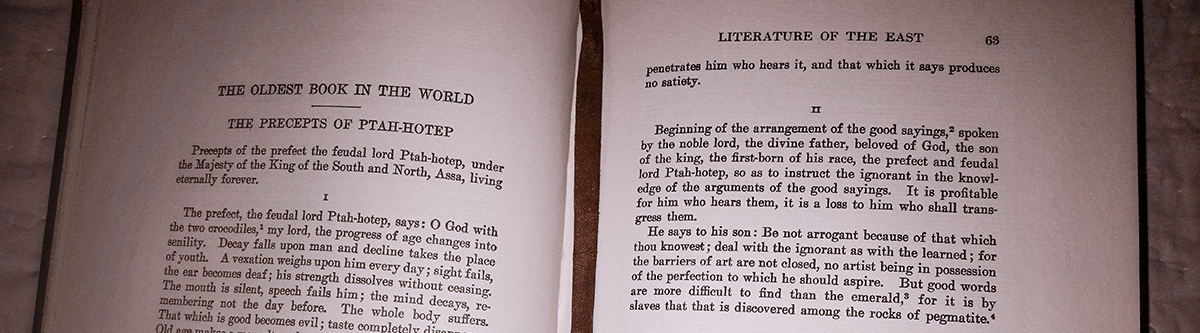
Perhaps you will argue, “but the website says it took the text from the book.” How do you know the website text is exactly the same as the book? In fact there are differences. The website text has been edited to make the language seem less archaic. Thou is replaced with you. And some key terms have been replaced. Ptah replaces God. Pharoah replaces King.
However, the main point here is to faithfully report your source, what you have seen with your own eyes. And that is the web page. What is the title of the text on the web page? Who are the producers of the web page? In what collection do you find it. On whose server? One thing that will not change between the book and the web page: who is the author of these teachings?
Eloquent Peasant
Middle Kingdom declaration of rights (following the “Osirian Revolution”). A tale of criminalization and resistance.
British Museum Papyrus
You can see why there are “holes” and variations.
Translation by Mark-Jan Nederhof in pdf format (U of St Andrews)
A Short Film
Declarations of Innocence
New Kingdom Answers to the Final Exam of Eternal Life
Papyrus of Ani
On Diop’s account, as a result of the “Osirian Revolution” of the First Intermediate Period, the salvation prayers of the Old Kingdom were made available in papyrus form so that common folks could also take the prayers to the grave with them.
Collections of these prayers are known to us today as The Book of the Dead; however, Karenga prefers to call it the Book of Salvation or the Book of Coming Forth by Day, because the redeemed soul would rise with the sun on the day after the death of the body.
One famous collection of prayers is the Papyrus of Ani, in which we find Plates XXXI and XXXII, the primary source texts of the “Declarations of Innocence” or “Negative Confessions.” The illustration portrays the lineup of judges that await the soul, along with the declarations that will allow the soul to avoid being condemned by each judge in turn.
Papyrus of Ani, Plate XXXI (Wikimedia Commons)
Budge Translation
Teachings of Amenemope
New Kingdom Advice to Young Scribes
“The Eloquent Peasant” above features a corrupt sheriff or land surveyor, a.k.a. “controller of the measure and recorder of the markers on the borders of the fields.” The Teachings of Amenemope (or Amenemapt) by contrast, is written by “the good sheriff” Amenemope, teaching his son how to be an honest and fair public servant. In some ways Amenemope echoes Ptah-hotep. In other ways he exudes a new spirit of righteousness that scholars call “personal piety.”
“Instruction of Amen-em-apt, son of Kanakht” (Sofiatopia)
Sofiatopia includes background and commentary. For the “primary source” please be sure to locate the text that is presented on papyrus patterned background.
Proverbs 22:17 – 24:22
Scholars at Solomon’s court made use of Egyptian teachings when they composed the book of Proverbs. Egyptian wisdom is quoted in the Bible.
See the “30 Sayings of the Wise,” a compendium of Egyptian wisdom teachings embedded into the wisdom of Solomon at Bible Hub (Proverbs 22:17 – 24:22).
Here is a good guide to MLA citation style for the Bible
Database recommendation: for work on the relationship between Amenemope and Proverbs search your library for the scholarly work of Nili Shupak.
Further Reading
Maat
The Egyptian Term for Goodness and Justice
Background reading (Wikipedia)
The Wikipedia page is not “primary source” text. But it’s a really good introduction.
Karenga, Maulana. Maat, the Moral Ideal in Ancient Egypt : A Study in Classical African Ethics. Routledge, 2004. EBSCOhost. Check your library for the ebook. The inventor of Kwanzaa has spent decades studying this topic.
Jeffers, Chike. “Embodying Justice In Ancient Egypt: ‘The Tale Of The Eloquent Peasant’ As A Classic Of Political Philosophy.” British Journal For The History Of Philosophy 21.3 (2013): 421-442.
Appendix
“Weight and Value” in the Ancient World
Researchers document a widespread adoption of standardized weights before and after 2000 BCE. The scale applied to a standardized weight became a powerful symbol of true value (Project “Weight and Value,” Georg-August U).
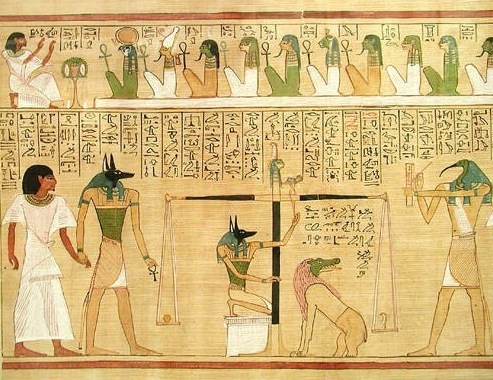
In the image below, the god of discernment, Anubis, weighs the heart of a soul against the true measure of a feather. Was the soul’s heart heavier than a feather? Maybe he should have paid more attention in Ethics class!
The “Eloquent Peasant” appeals to the governor:
You are just, like the balance
If it is crooked, then you must be crooked (Nederhof 193-94)
Your tongue is the pointer (of the balance),
Your heart is the weight, and your lips are its arms (Nederhof 197-98)
And the “good Sheriff” Amenemope counsels his son:
Chapter 16 : do not corrupt the balance
01 Do not tamper the scales, nor falsify the weights,
05 The Ape sits by the balance,
06 his heart is in the plummet.
07 Where is a god as great as Thoth?
10 they are rich in grief through the might of god.
16 if he cheats before the god?
Chapter 17 : do not corrupt the measure
04 nor let its belly be empty.
09 The bushel is the Eye of Re,
10 it abhors him who trims.
16 so as to defraud the share of the residence.
18 than an oath by the great throne. (Sofiatopia)
Compare Proverbs 16:11
Honest scales and balances belong to the Lord;
all the weights in the bag are of his making. (Bible Gateway).
 CourseLinks

You must be logged in to post a comment.