Updated Spring 2026
with much gratitude to the Chinese Text Project
The Four Books of Confucianism
Core Curriculum of Classical Chinese Education for Centuries
(1) Great Learning by Confucius: A mission statement for higher education. “Things have their root and their branches.”
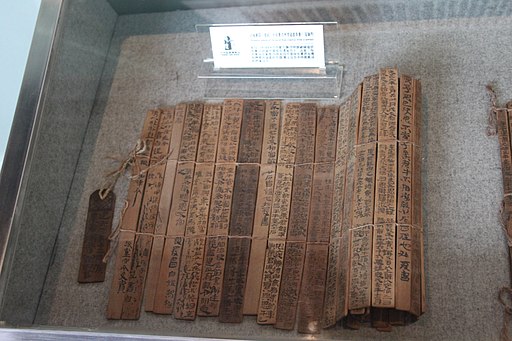
(2) Analects of Confucius: A great bundle of teachings.
Suggested Passages
1.1 “Is it not pleasant”
2.1 North Star
2.3 Autobiography
3.3 Humanity
4.5 Virtue
6.30 Others
12.22 Constancy
17.6 Five Things
12.17 / 13.3 / 13.13 Rectify Names
17.8 Dialectical Unity of Opposites in Education (see Xiaoxia Chen below)
Suggested search terms: superior man, cultivation (cultivat*), virtue, rectify (rectif*), right [PS: in my opinion, ‘superior man’ should be translated as ‘cultivated person’]
*credit for some selections from The Analects goes to: Wong, David B. “Early Confucian Philosophy and the Development of Compassion.” Dao, vol. 14, no. 2, June 2015, pp. 157–94, doi:10.1007/s11712-015-9438-x. (Library login required)
(3) Doctrine of the Mean by Tsze-sze, Grandson of Confucius
a.k.a. Zhong Yong
Mencius (Mengzi)
(4) The Mencius
In the left column of the Chinese Text Project, scroll down to “Search” then search under “Confucianism” for the term “passion-nature“
Xunxi
Overview from the Stanford Encyclopedia of Philosophy
Selections from Human Nature is Evil (pdf from Columbia U)
Confucian Environmental Philosophy
Boyung Lee: “A Confucian Perspective on Western Notions About Globalization” (undated @ 2004; appeals to “Mencian Confucianism;” check library databases for more work by this Christian-Confucian Theologian)
Can Confucianism Save the World? (YouTube)
Confucian Statement on the Protection of the Planet
Secondary Literature
Chen, Xiaoxia. “Harmonizing Ecological Sustainability and Higher Education Development: Wisdom from Chinese Ancient Education Philosophy.” Educational Philosophy & Theory, vol. 51, no. 11, Oct. 2019, pp. 1080–1090. (Library Login Required)
–With special attention to Xue Ji, “the earliest treatise on education and teaching in ancient China, even in the world, generalizes the social function of education into two interrelated aspects: cultivating the talents needed by the country and shaping positive social morality.” Find Xue Ji under Confucian LiJi at the Chinese Text Project: https://ctext.org/liji/xue-ji
Christensen, Jan Erik. “Building an Environmental Ethics from the Confucian Concepts of Zhengming and Datong.” Asian Philosophy, vol. 24, no. 3, Aug. 2014, pp. 279–293. [Zhengming: Rectification of Names; Datong: Great Harmony]
Daoism
Laozi
Overview from the Stanford Encyclopedia of Philosophy
38. “propriety is the attenuated form”.
Zhuangzi
Overview from the Stanford Encyclopedia of Philosophy
21st Century
Daoist Faith Statement on Conservation
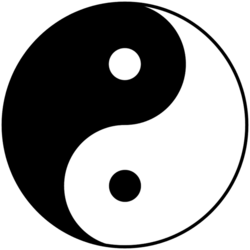
Taiji
How to Gather Your Chi (YouTube)
Neo-Confucianism
Zhou Dunyi
Overview from the Internet Encyclopedia of Philosophy
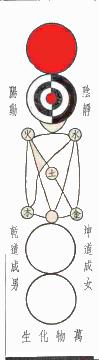
Variant of the Taijitu Wikimedia Commons
Presentation of the Diagram of Supreme Polarity (taiji) with excerpts from two of Zhou Dunyi’s works: the “Explanation” and the Tongshu (Joseph A. Adler’s pages at Kenyon College)
Robin R. Wang
Zhou Dunyi’s Diagram of the Supreme Ultimate Explained (“Taijito Shuo”): A Construction of the Confucian Metaphysics (Loyola Marymount University)
“Kundao 坤道: A Lived Body In Female Daoism.” Journal Of Chinese Philosophy 36.2 (2009): 277-292. Religion and Philosophy Collection. Web. 17 Aug. 2013.
Yijing (I Ching)
An ancient system of meaning built from two symbols: a broken line (yin) and a solid line (yang).
Stanford Encyclopedia of Philosophy

Hexagram 30 “Radiance” Wikimedia Commons
Digital Coin Toss (Ewald Berkers)
Further readings
Zhang, Shi-Ying. “Philosophy And Aesthetic: To Begin With The Case Of Western Postmodern Art.” Open Journal Of Philosophy 2.2 (2012): 136-142.
From the Abstract: “Since the middle of the last century, under the influence of traditional Western philosophy, Chinese philosophy lost its traditional beauty. To keep this beauty, we need to go further and understand philosophy as a discipline to upgrade the realm of life. The beauty of life realm comes before the beauty of philosophy. Therefore, Chinese philosophy needs to become life-oriented like postmodern art. Inheriting and developing Daoism philosophy while absorbing the philosophy of life shown through postmodern art, seems to be a good way for us to enhance the realm of life and pursue the beauty of philosophy.”
From the article: “Confucianism makes moral realm the highest realm of life. It also advocates “heaven-man unity”, but its “heaven” is moral to a great extent. Despite all that, its “heaven-man unity” remains to be poetic, for it tries, through a poetic and aesthetic consciousness, to turn a moralized “heavenly principle” into a spontaneous pursuit of the mind. By contrast, Daoism clearly regards aesthetic realm the highest realm of life, and its philosophy features the beauty of philosophy.” (140)
 CourseLinks


You must be logged in to post a comment.