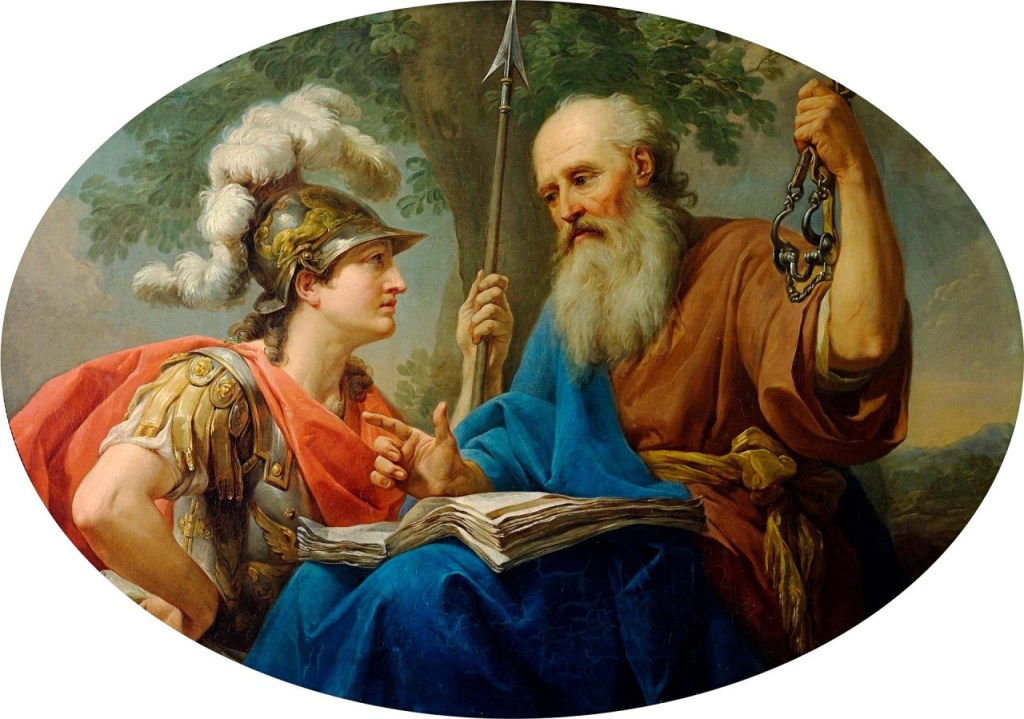
SOCRATES: But would you say that the good are the same as the bad?
ALCIBIADES: Certainly not.
SOCRATES: Then whom do you call the good?
ALCIBIADES: I mean by the good those who are able to rule in the city.
SOCRATES: Not, surely, over horses?
ALCIBIADES: Certainly not.
SOCRATES: But over men?
ALCIBIADES: Yes.
SOCRATES: When they are sick?
ALCIBIADES: No.
SOCRATES: Or on a voyage?
ALCIBIADES: No.
SOCRATES: Or reaping the harvest?
ALCIBIADES: No.
SOCRATES: When they are doing something or nothing?
ALCIBIADES: When they are doing something, I should say.
SOCRATES: I wish that you would explain to me what this something is.
Revised 2026 Spring
Background Browsing
https://en.wikipedia.org/wiki/Plato
Prof Notes
http://infiniteloom.shoutwiki.com/wiki/Plato
Selected DIALOGUES
The Dialogues of Plato typically portray Socrates in conversation. Commonly, the name of the dialogue is the name of the person that Socrates is talking to. Don’t try to skim a dialogue by Plato. You have to be prepared to live in the conversation as it unfolds.
Alcibiades
Sanderson Beck’s Translation of Alcibiades
Note: Plutarch wrote a life of Alcibiades, a classic cautionary tale.
Phaedrus
Phaedrus at MIT Classics
Note: there are three speeches in this dialogue; best to quote from the third speech, which begins with Socrates saying, “I told a lie.”
Here’s an image of famous plane tree.
Symposium
Symposium at MIT Classics
Note: find “Diotima” for the final answer from Socrates
Speech of Aristophanes
Speech of Aristophanes at YouTube
Republic
Plato’s Republic at MIT Classics
Reminder: Intro is not primary source text.
Note: to locate the thesis of The Republic, find “ultimate” in Book IV.
(Recent research by Armand D’Angou argues that Aspasia — the great mentor of Athens — is the historical basis for Plato’s Diotima; therefore, the thesis of Plato’s Republic is a precise reflection of what — on Plato’s account — Aspasia taught Socrates to say in the Menexenus: that the one who has life ordered to the best is “temperate and valiant and wise.” [Menex. 248a / Repub. 4.433b / sophron, andreios, phronesis])
Allegory of the Cave (Book VII)
Allegory of the Cave narrated by Orson Welles
20th Century Interlude
Ngugi wa Thiong’o. “The Allegory of the Cave: Language, Democracy and a New World Order!” Lecture III of the Clarendon Lectures in English, Oxford, May 15, 1996. in Black Renaissance/Renaissance Noire Vol. 1, No. 3. or Penpoints, Gunpoints, and Dreams: Towards a Critical Theory of the Arts and the State in Africa, Clarendon Press, 1998:
“The allegory is meant to be a vivid visual image of the human condition: its ignorance and the means of its enlightenment. But in the context of colonial domination and resistance, Plato’s dark chamber would more likely look like an image of the colonial condition.” (Thiong’o Sec. I)
“What language is the man of vision using in talking to the people in the cave? Is the language spoken by the prisoners in the cave the same as the one spoken by the interpreter?” (Thiong’o Sec. I)
“There are three types and three roles into which he could fall and indeed has fallen in the colonial and postcolonial era: the interpreter as a foreign agent and messenger, as a double agent, and as a people’s scout and guide to the stars of freedom.” (Thiong’o Sec. II)
Plato’s Cosmology
Timaeus
No doubt you have heard of Atlantis? But did you know that this dialogue is the source of the rumor?
http://classics.mit.edu/Plato/timaeus.html
Platonic Solids (Background)
http://en.wikipedia.org/wiki/Platonic_solid
Platonic Solids (Video)
http://www.youtube.com/watch?v=voUVDAgFtho
Prof Notes
http://infiniteloom.shoutwiki.com/wiki/Timaeus
Database Suggestion
Smith, Anne Collins, and Owen M Smith. “Voldemort Tyrannos: Plato’s Tyrant In The ‘Republic’ And The Wizarding World.” Reason Papers: A Journal Of Interdisciplinary Normative Studies 34.1 (2012): 125-136. Philosopher’s Index.
 CourseLinks