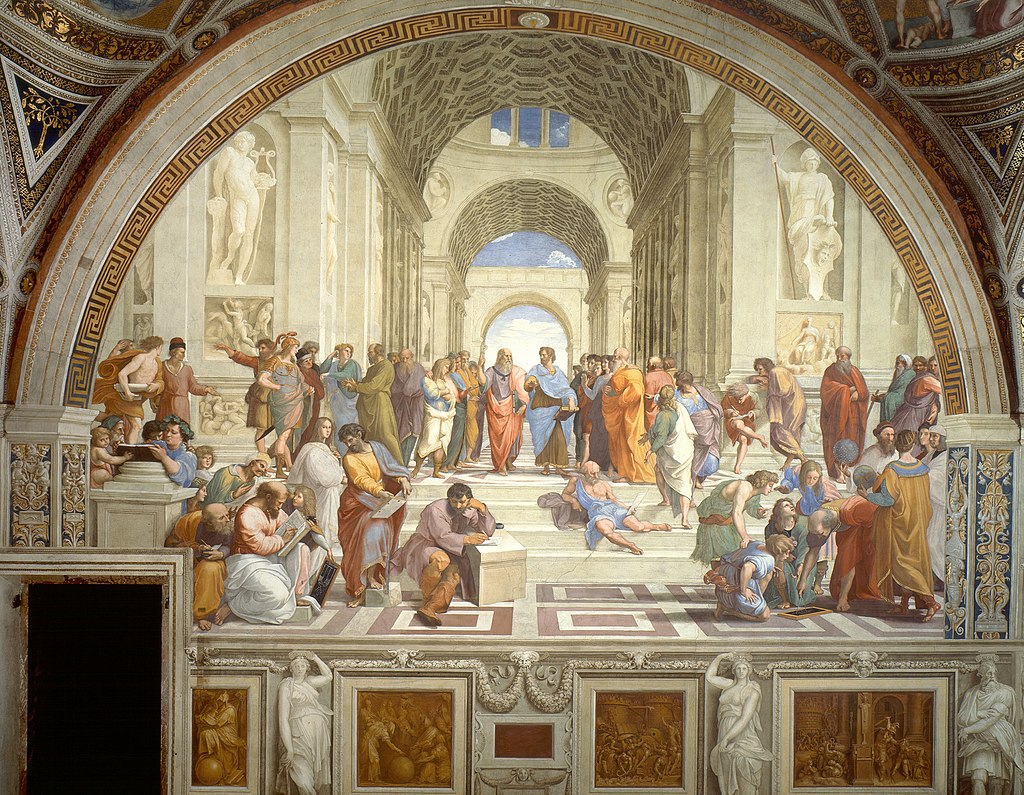
Key to figures in The School of Athens painting by Raphael
Revised 2025 Spring
Background Browsing
http://en.wikipedia.org/wiki/Aristotle
Selected TEXTS
Aristotle’s Ethics
Ethics for natural human beings.
Table of Contents to Aristotle’s Nicomachean Ethics @ Nothingistic
Note: The page is a table of contents only. Don’t forget to click into the books themselves to get authoritative quotes! Also, please check your course title. If the course is about Ethics, this is your primary source text!
Aristotle’s Naturalist Metaphysics
All things are natural
Four Causes (Metaph. 5.2)
Aristot. Met. 5.1013a @ Perseus
In other words: every natural thing has four causes: (a) the Material cause: or the stuff it’s made of (b) the Formal cause: or the design of it (c) the Efficient cause: or what puts the stuff into the design, and (d) the Final cause: or the purpose of it (or the use).
Nature (Metaph 5.4)
Aristot. Met. 5.1015a @ Perseus
“And nature in this sense is the source of motion in natural objects, which is somehow inherent in them, either potentially or actually.”
First Mover
Aristot. Met. 12.1071b @ Perseus
“there must be some substance which is eternal and immutable”
De Anima / On the Soul
The Soul, also, is a natural thing that depends upon a body.
Bk. II @ Internet Classics Archive, MIT
Bk. II, Pt. 1: “it indubitably follows that the soul is inseparable from its body”
Bk. II, Pt. 2: “the body cannot be the actuality of the soul; it is the soul which is the actuality of a certain kind of body”
In other words, where there is no body, there can be no soul.
21st Century
Sliwa, Martyna, and George Cairns. “Developing A New Ethics Of International Business: Possibilities And Role Of Educators.” Ethics and organizational practice: Questioning the moral foundations of management. 17-35. Northampton, MA, US: Edward Elgar Publishing, 2010. PsycINFO. 21 Aug. 2016.
“Our overview of the values and ethics underpinning IB (International Business) theories and managerial practice promoted in the mainstream texts leads us to conclude that they do not provide a basis for the establishment of responsible and sustainable systems, norms, incentives and behaviors.
“We therefore try to answer the question, to what extent and in what way can we, as IB academics and educators, contribute to the development of IB knowledge, which would challenge the current rhetoric of neo-liberal market economics and profit maximization.
“In doing so, we propose an ethical paradigm for building IB theory and practice drawing upon a contemporary interpretation of Aristotle’s concept of phronesis, or ‘prudence’, found in his Nicomachean Ethics. We locate our discussion within the tradition of a critical pedagogy that is committed to ‘personal and societal transformation towards more just, free and equitable conditions through an integrative combination of critical analysis and collective action’.” (Sliwa, et.al. Abstract; emphasis and paragraph breaks added).
also
Grandy, Gina, and Martyna Sliwa. “Contemplative Leadership: The Possibilities for the Ethics of Leadership Theory and Practice.” Journal of Business Ethics (2015): 1–18.
“Following from Aristotle, we propose that contemplative leadership takes into account abstract knowledge (sophia), technical knowledge (téchnē), and practical wisdom (phronēsis). Moreover, contemplative leadership bridges individual, societal, and organizational considerations of justice and is grounded in an appreciation of “good purpose” (Moore 2012).”
. . . some other books by Aristotle . . .
Politics
http://www.gutenberg.org/ebooks/6762
On Interpretation
On Interpretation at MIT Classics
Poetics
http://www.gutenberg.org/ebooks/1974
Database suggestion:
Gallagher, Robert L. “Incommensurability In Aristotle’s Theory Of Reciprocal Justice.” British Journal For The History Of Philosophy 20.4 (2012): 667-701. Philosopher’s Index. Web. 6 Jan. 2014.
Note: see Nich. Eth. V.5.
 CourseLinks
